
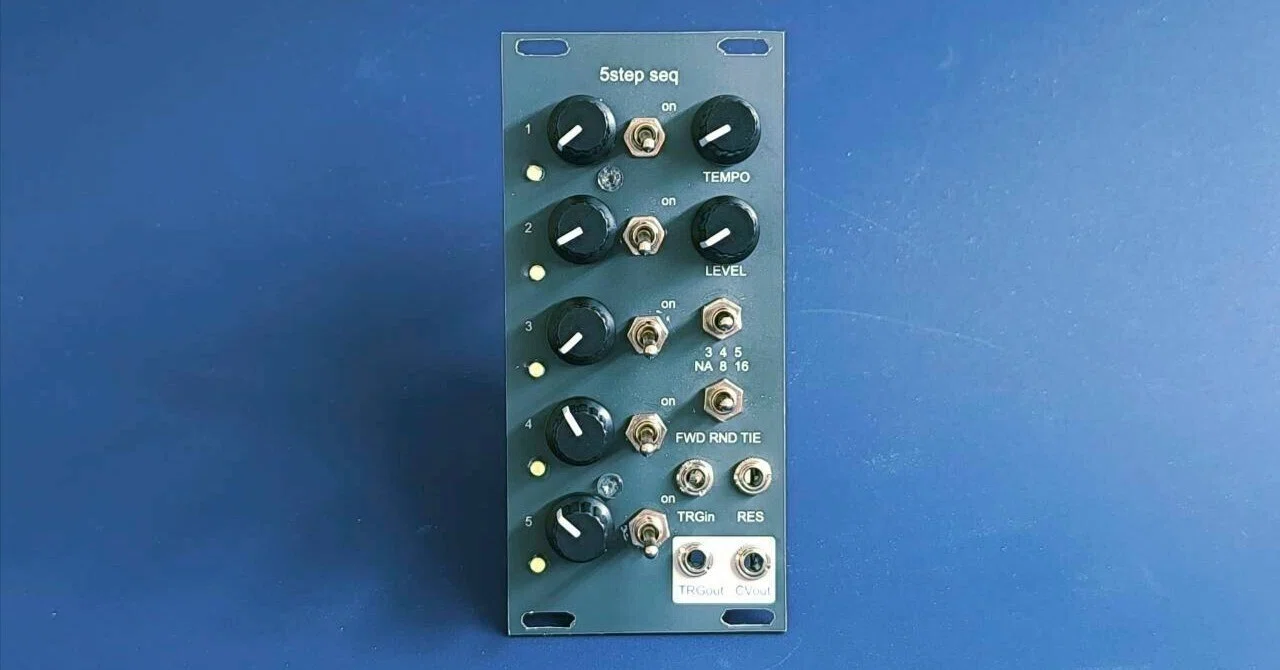
5 Step Seq: A Buchla-Inspired DIY Project by HAGIWO
Hey synth DIYers! Today we’re diving into another brilliant and budget-friendly project from the prolific HAGIWO: the 5 step seq. It’s an Arduino-based sequencer inspired by the unique, groove-making modules from the legendary Buchla Easel.
📣 Live Show Announcement!
We will be discussing the 5 step seq LIVE on the Synth Geekery show!
When: Saturday, 15th November 2025
Where: https://youtube.com/watch?v=tOyRlFShAAE
Don’t miss it!
Project Overview
This module is HAGIWO’s 88th creation, and it’s a special one. If you love the quirky, non-linear patterns from Buchla sequencers (which use odd step counts like 3 and 5), this project is for you. Instead of just copying, HAGIWO has created a modern, digitally-controlled module with a pure analog output.
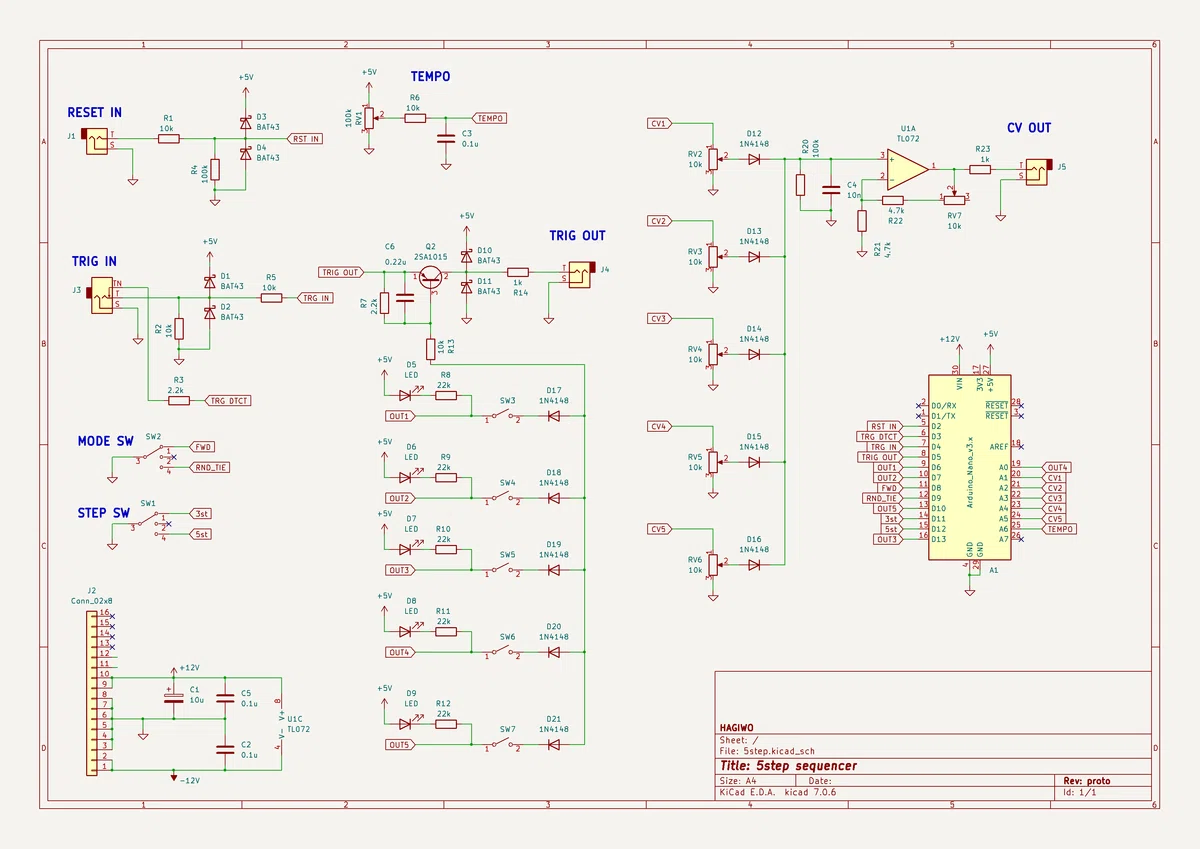
The brain is an Arduino Nano, but clever design means no DAC or PWM is used for the output. This results in a simple circuit with excellent voltage stability and responsiveness, giving you clean, predictable CV signals.
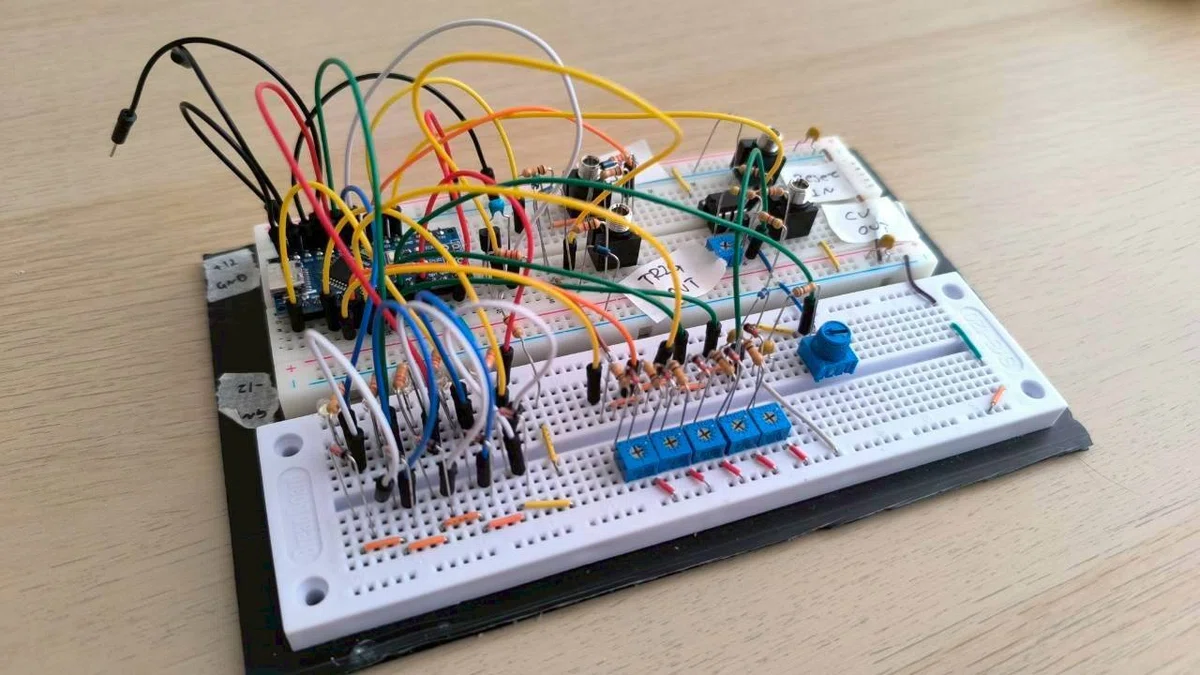
Features
This little 10HP module is packed with features:
- Dual-Mode Sequencer: Switch between two distinct operational modes.
- 1. Step Sequencer Mode (FWD): Classic forward-moving sequencer. You can select 3, 4, or 5 steps to create those famous odd-time-signature grooves.
- 2. Random Sequencer Mode (RND/TIE):
- RND: A standard random step generator.
- TIE: A random mode where steps have a chance of becoming a “Gate” (tied note) instead of just a “Trig.”
- In random mode, you can select NA (a 256-step full random sequence), 8 steps, or 16 steps.
- Per-Step Control:
- CV Pots (x5): A dedicated knob for each of the 5 steps to set its CV output level.
- Trig SW (x5): A switch for each step to turn its trigger output on or off, perfect for creating rhythmic variations.
- I/O and Global Controls:
- Tempo Pot: Controls the internal clock speed.
- Level Pot: Adjusts the overall CV output range (0-10V+).
- Trig In: An external clock input. Plugging in a cable automatically switches from the internal to the external clock.
- Reset In: A standard reset input to restart the sequence.
- Trig Out: Outputs a 0-5V Trigger or Gate signal.
- CV Out: Outputs the main CV signal (0-10V+).
- LEDs: 5 bright LEDs show you which step is currently active.
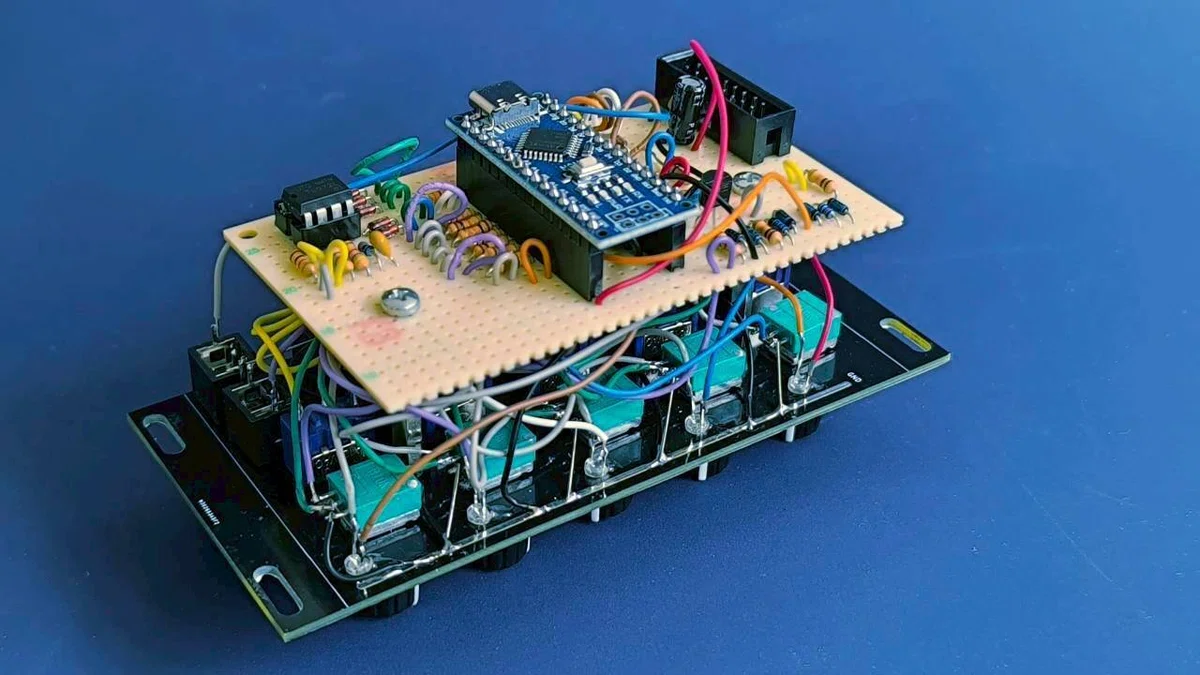
Summary Table
Here are the quick specs for your Eurorack case:
| Specification | Value |
| Format | Eurorack |
| Size | 3U, 10HP |
| Power | 40mA (+12V) |
| 5mA (-12V) |
Build Cost & Sourcing
One of the best parts of HAGIWO’s projects is the ultra-low cost. This entire module can be built for approximately $11!
Here’s a rough breakdown of the main parts:
- Arduino Nano: $3
- Potentiometers (x7): $2.10 ($0.30 each)
- Switches (x7): $1.40 ($0.20 each)
- Front Panel: $1.50
- TL072 Op-Amp: $0.20
- Other Components: ~$2.80 (resistors, capacitors, jacks, etc.)
For sourcing components, the article recommends checking out HAGIWO’s general list of cheap DIY parts [2]. The circuit uses a common 2SA1015 transistor, but the designer notes that any common NPN transistor should work just fine. It’s also recommended to use high-brightness LEDs so you can easily see your sequence in action.
All the circuit diagrams and Arduino code are available on the project page [1].
Happy building, and see you at the live show!
Footnotes
[1] HAGIWO’s “5 step seq” Project Page: https://note.com/solder_state/n/nf6c29a7075cd
[2] HAGIWO’s List of Cheap DIY Modular Synth Parts: https://note.com/solder_state/n/n4a62c6d4e56d (Linked from the main article)
[3] Synth Geekery Live Show Link: https://youtube.com/watch?v=tOyRlFShAAE